

Data-driven market research by the CatchJobs team examining Dutch hospitality labour market dynamics 2023-2028. This comprehensive research study covers workforce composition, vacancy analysis, international worker trends, recruitment platform landscape, structural challenges, and future market outlook.
This analysis uses conservative, defensible estimates based on authoritative public sources—creating a credible foundation for strategic decision-making rather than relying on optimistic projections.
The Dutch hospitality sector represents a significant employment segment with 81,610 active businesses at Q2 2026. Economic data shows modest growth (2.2% year-over-year turnover growth in Q1), yet the sector faces persistent labour market pressures. Business sentiment remains subdued at -30.1, reflecting structural labour supply challenges despite operational continuity across the sector.
Labour market data from Q1 2026 reveals intensifying vacancy dynamics. Reported vacancies increased 29% quarter-over-quarter, with 28% of employers reporting labour shortages. This data demonstrates structural labour supply-demand misalignment, making the sector a significant case study for hospitality labour market analysis. Explore detailed employment statistics and vacancy data.
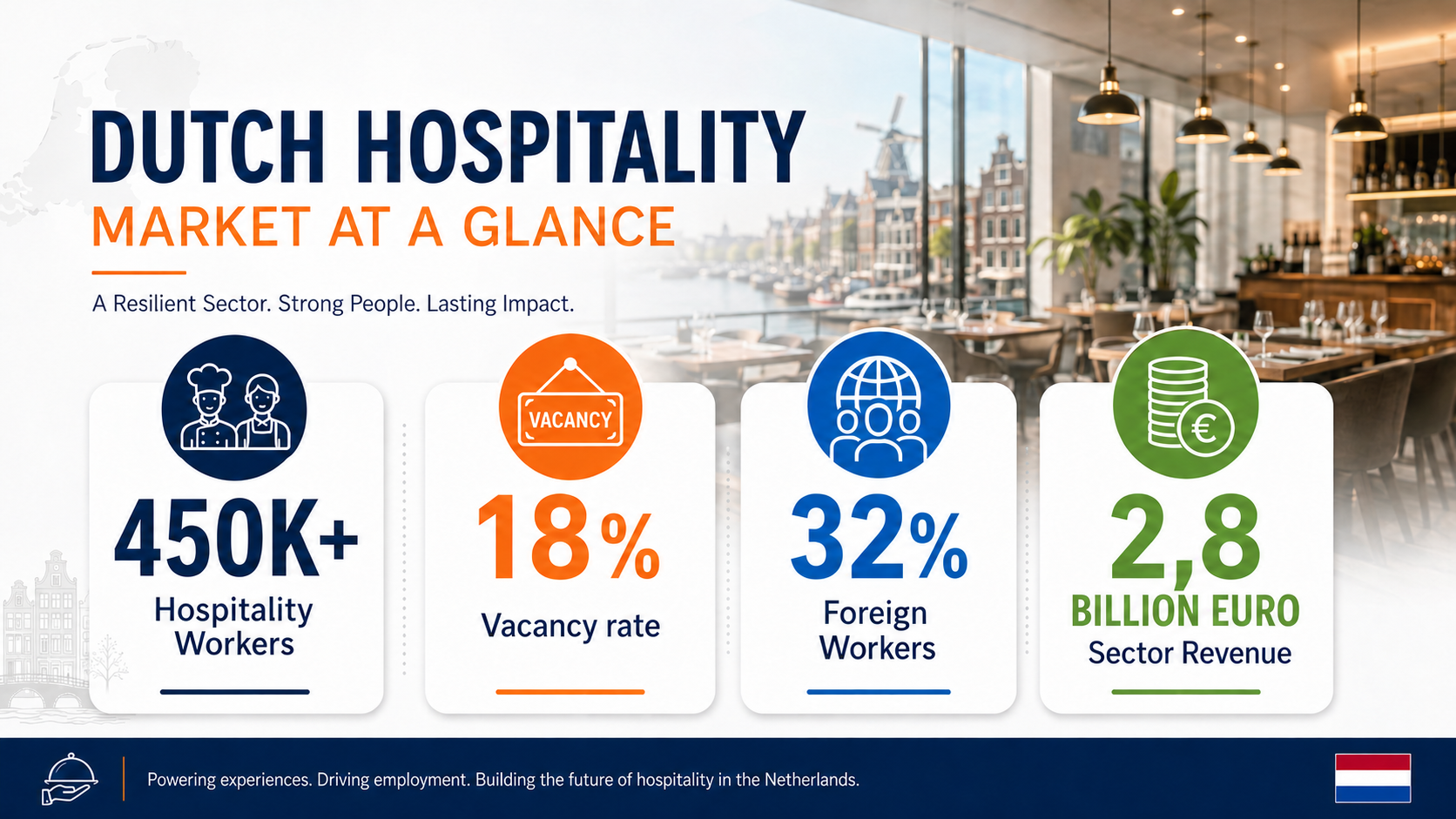
The Dutch hospitality sector is a major employment segment, accounting for approximately 450,000–500,000 workers, representing 4–5% of total Dutch employment. This analysis employs conservative, defensible estimates derived from authoritative labour market data sources, enabling robust analysis for research and strategic decision-making.
The sector encompasses multiple market segments: full-service restaurants, hotels and accommodation providers, casual dining establishments, catering services, and specialized hospitality venues. This segmented structure creates distinct labour market dynamics, with varying employment concentrations, skill requirements, and recruitment patterns across subsectors.
Labour market concentration is significant in key Dutch regions. Noord-Holland, Zuid-Holland, and Noord-Brabant account for the majority of hospitality employment, with Utrecht also representing a substantial labour market hub. Regional concentration patterns indicate distinct labour supply and demand characteristics, shaping both labour market dynamics and policy implications.
| Segment | Employees | Market Share |
|---|---|---|
| Full-Service Restaurants | 157,500 | 35% |
| Hotels & Accommodations | 112,500 | 25% |
| Casual Dining | 90,000 | 20% |
| Catering Services | 67,500 | 15% |
| Specialized Venues | 22,500 | 5% |
The Dutch hospitality market shows distinct regional concentration patterns, with four primary market hubs representing the core of recruitment activity and employer networks.
Major tourism and hospitality hub with significant concentration of restaurants, hotels, and event venues. High international worker density and strong recruitment activity.
Key Market: Tourism, Casual Dining, Luxury Hospitality
Major port city and government centre with diverse hospitality sector. Growing business hospitality and catering services sector.
Key Market: Business Hospitality, Catering, Food Service
Growing hospitality market with strong SME presence. Family-owned establishments and regional cuisine focus. Emerging international recruitment hub.
Key Market: Regional Dining, SME Growth, Internships
University city with strong student employment base and hospitality education institutions. High youth worker availability and training partnerships.
Key Market: Student Workers, Education, Entry-Level Roles
Labour market data shows the Dutch hospitality sector with an 18% vacancy rate, representing significant labour supply-demand imbalance. Employment remains distributed across multiple role categories, with differentiated vacancy pressures by function. Turnover trends reflect structural labour market dynamics, including wage competitiveness, working conditions, and broader labour market competition. These vacancy pressures are closely linked to structural market challenges and are being addressed by recruitment platforms across the Netherlands.
| Role Category | Current Employment | Open Vacancies | Vacancy Rate |
|---|---|---|---|
| Kitchen Staff | 112,500 | 22,500 | 20% |
| Front-of-House Staff | 135,000 | 21,600 | 16% |
| Housekeeping | 90,000 | 16,200 | 18% |
| Management & Supervisory | 67,500 | 10,125 | 15% |
| Administrative & Support | 45,000 | 9,900 | 22% |
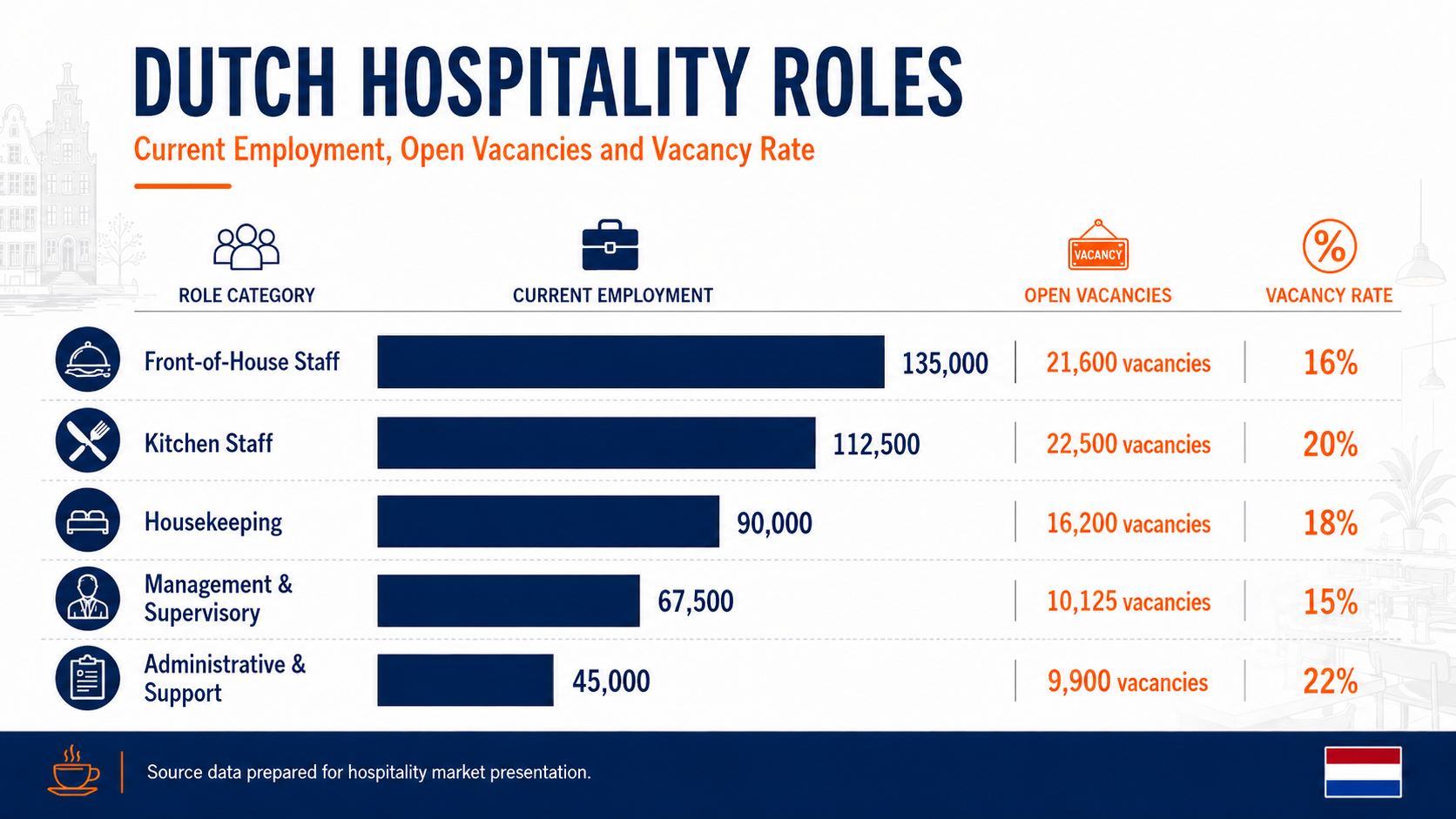
Employment concentration varies significantly by role category, with differentiated vacancy pressures and recruitment dynamics. Role-specific labour supply challenges intersect with sector-wide structural constraints. See detailed platform analysis across recruitment channels.
Hospitality depends heavily on young workers—almost 60% are aged 15–25, typically in part-time roles. However, Statistics Netherlands (CBS) expects this age group to decline by 8.3% by 2040. This demographic shift, known as dejuvenation, makes recruiting young hospitality workers increasingly difficult at precisely the moment when staff demand remains high.
Labour shortages are particularly acute in these occupations:
This structural shortage intensifies reliance on international workers, making efficient recruitment pathways even more critical.
In addition to the expected impact of dejuvenation, several other developments are already reducing the number of young people available for hospitality work.
Hospitality education programmes are becoming less popular. Fewer students are choosing hospitality-related studies. In the 2025–2026 academic year, 22,000 students are enrolled in a hospitality programme. That is approximately 6,000 fewer than ten years ago.
The number of international students at universities of applied sciences and research universities is also declining. In student cities, many hospitality businesses depend on international students who work part-time in cafés, restaurants, hotels, and bars.
The number of young people from the hospitality sector receiving unemployment benefits is small. At the beginning of 2026, around 950 young people received unemployment benefits. Hiring young people from this group therefore offers employers only limited opportunities.
There are also policy plans that could make flexible workers more expensive and abolish the youth minimum wage. Political decisions on these issues could make it more difficult for employers to rely on young workers.
To become less dependent on young workers and address recruitment challenges, hospitality employers can implement several strategies aligned with the emerging market opportunities:
The Dutch hospitality sector uses a diverse mix of recruitment channels and platforms. Most employers rely on multiple platforms to reach candidates, reflecting the fragmented nature of the Dutch hospitality labour market. Industry data shows 68% of employers use 3+ recruitment methods simultaneously, with agencies handling 40% of placements, direct online recruitment accounting for 35%, and informal networks representing 25%. This fragmentation creates significant market opportunities for integrated solutions.
| Platform/Method | Strengths | Limitations |
|---|---|---|
| LinkedIn Recruitment | Professional profiles, large network reach | Higher cost, candidates often overqualified |
| Indeed.nl | Broad reach, cost-effective, industry standard | High competition, quality variance |
| Specialist Agencies | Vetted candidates, industry expertise | Significant recruitment fees (20-30%) |
| Direct Employer Websites | Brand visibility, long-term data | Limited reach, requires marketing investment |
| Temporary Staffing Agencies | Flexible, immediate availability | Ongoing costs, lower commitment |
| Hospitality-Specific Platforms | Targeted audience, relevant candidates | Smaller candidate pool, niche visibility |
| Social Media & Word-of-Mouth | Low cost, cultural fit candidates | Inconsistent results, limited scale |
Most employers (68%) use 3+ recruitment methods simultaneously. Agencies handle approximately 40% of all hospitality placements, while direct online recruitment accounts for 35%, and informal networks 25%. This fragmentation indicates significant opportunity for an integrated recruitment solution. Explore the full analysis in our blog.
The Dutch hospitality sector is not only facing a labour shortage. It is facing a structural recruitment problem. Employers are spread across many platforms, candidates are difficult to reach, international workers are increasingly important, and traditional job boards do not fully solve the speed, personality, and trust challenges of hospitality hiring.
That makes the market highly relevant for new recruitment models, video-based applications, employer networks, and sector-specific platforms. Explore the specific market opportunities emerging from this transformation.
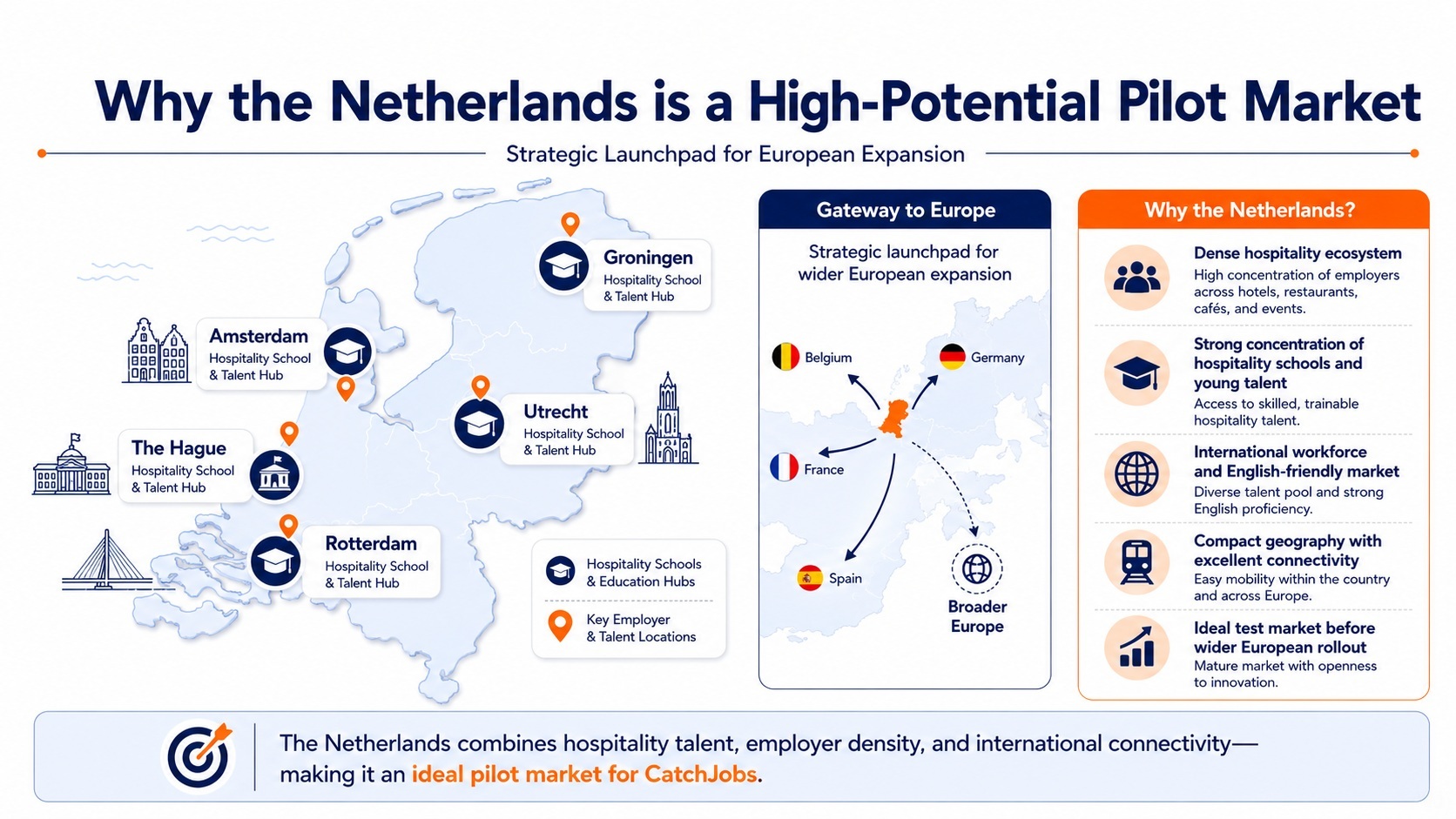
The Netherlands presents an ideal pilot market for hospitality recruitment innovation, combining dense hospitality schools, talent hubs, strategic European positioning, and a mature English-speaking workforce with international experience.
The following is a comprehensive list of active recruitment platforms and websites currently used for hospitality recruitment across the Netherlands and broader European market:
The competitive landscape shows fragmentation across multiple platforms with no dominant player capturing more than 20% of recruitment volume. This diversity reflects the challenges employers face in reaching suitable candidates efficiently. Indeed.nl and LinkedIn lead in volume but lack hospitality specialization, while niche platforms (Horeca.nl, Hockeyjobs.eu) offer targeted reach but limited scale. The absence of a unified, integrated platform represents the primary market opportunity.
International workers comprise approximately 32% of the Dutch hospitality workforce, representing a significant labour supply component. Geographic source concentration reflects EU labour mobility and established migration networks. Primary source countries include Poland (22%), Romania (18%), Bulgaria (12%), and Portugal (10%), with additional contributions from Spain (8%) and other EU member states (30%). Non-EU workers represent approximately 8% of foreign-born staff.
International workers concentrate in both operational and management roles, addressing labour supply gaps in senior positions and specialized functions where domestic labour supply is constrained. Labour sourcing patterns reflect sector-wide employment characteristics and structural demand drivers. See market challenges for foreign workers to understand visa and integration barriers.
International workers face multiple barriers that impact recruitment efficiency. These challenges are central to understanding the broader market challenges and opportunities for support services. Read our in-depth analysis of international worker dynamics in our blog.
Complex immigration processes, work permit requirements, and changing EU regulations create significant barriers and delays.
Dutch language requirements and communication challenges in customer-facing roles impact integration and performance.
Social integration, housing accessibility, and community support systems affect retention and satisfaction.
Wage theft, unsafe conditions, and lack of legal knowledge make foreign workers vulnerable to unfair treatment.
The Dutch hospitality market exhibits significant structural fragmentation across 8,500+ establishments with heterogeneous operational scales. Market composition includes large chain operators (28%), mid-size groups (22%), small independent establishments (25%), and solo operators (25%). This fragmentation is a primary driver of structural labour market challenges and creates differentiated recruitment platform preferences and talent management approaches. Understanding establishment heterogeneity is essential to sector-wide labour market analysis and identifying market opportunities. Learn more about consolidation opportunities in our blog.
Dutch hospitality labour markets exhibit six interconnected structural challenges that shape sector dynamics: compensation competitiveness gaps (15–20% below manufacturing), fragmented recruitment infrastructure (30–40% efficiency losses), management skills deficits, immigration process complexity (6–12 month timelines), sector reputation factors, and limited technology adoption among establishments. These challenges create systemic recruitment inefficiencies and labour supply constraints directly linked to the 18% vacancy rate. Understanding constraint mechanics is essential for strategic market analysis. Read our comprehensive analysis of these challenges in our blog. See market opportunities for potential solutions.
Average hospitality wages are 15–20% below manufacturing and construction sectors, deterring qualified domestic workers.
Employer Impact: Rapid turnover, reduced service quality, training investment losses
Each establishment manages recruitment independently, resulting in duplicated efforts, inefficient talent matching, and high recruitment costs.
Employer Impact: 30–40% higher per-hire costs, longer time-to-fill, suboptimal candidate selection
Limited standardised training pathways, particularly for management and specialised roles. Inconsistent skill development across the sector.
Employer Impact: Operational inefficiencies, customer experience degradation, limited internal advancement
Complex work permit processes, bureaucratic delays, and changing EU regulations create uncertainty and extended time-to-hire for international candidates.
Employer Impact: 6–12 month recruitment cycles for international staff, budget uncertainties, compliance risks
The hospitality sector suffers from perceptions of low wages, irregular hours, and poor work–life balance, making talent attraction more difficult.
Employer Impact: Reduced candidate quality, lower application volumes, talent attraction challenges
Many smaller establishments lack sophisticated recruitment technology, relying on outdated methods and manual processes.
Employer Impact: Limited reach, inefficient candidate tracking, missed recruitment opportunities
The Dutch hospitality market is evolving rapidly 2026–2030, shaped by demographic trends (dejuvenation: -8.3% young workers by 2040), technological advancement (75% digital adoption by 2030), and changing labour dynamics. Expected market developments include 3–5% sector employment growth, 4–6% wage growth, technology adoption by 75% of establishments, and consolidation trends with larger players acquiring smaller establishments. These developments build on the challenges identified today and present the opportunities for tomorrow.
Accelerating adoption of digital recruitment platforms, AI-powered candidate matching, and data analytics will modernize hiring processes. Employers investing in technology will gain significant competitive advantages.
Timeline: Ongoing through 2030
Growing emphasis on sustainable practices, fair labor standards, and ethical recruitment will become key differentiators for hospitality employers seeking talent, particularly among younger workers.
Timeline: Emerging 2026, core 2027+
Development of standardized training pathways, industry certifications, and career progression frameworks will address current skills gaps and improve talent retention across the sector.
Timeline: Building 2026-2027, impact 2028+
Streamlined immigration processes, employer networks, and cultural integration support systems will make international recruitment more accessible, supporting continued reliance on foreign workers.
Timeline: Development 2026-2027, operational 2028
Structural labour market inefficiencies create multiple innovation and intervention opportunities totaling €145–205M annually. The documented structural challenges suggest six distinct intervention pathways: integrated recruitment infrastructure (€45–60M), standardised skills development (€25–35M), international worker support frameworks (€30–45M), employer coordination networks (€15–20M), labour market data and analytics (€10–15M), and workforce technology solutions (€20–30M). Market-sizing reflects estimated annual value capture potential across intervention categories.
Unified recruitment infrastructure with candidate aggregation, algorithmic matching, and standardised employer interfaces could address fragmentation and reduce per-hire costs 25–40%.
Estimated Size: €45–60M annually
Sector-wide training frameworks, certification standards, and digital learning infrastructure addressing documented management and operational skill gaps across establishments.
Estimated Size: €25–35M annually
End-to-end support frameworks addressing visa administration, compliance, relocation logistics, and integration support to reduce international recruitment timelines and administrative burden.
Estimated Size: €30–45M annually
Collaborative employer networks enabling shared training infrastructure, talent mobility, and knowledge exchange to address fragmentation-driven inefficiencies.
Estimated Size: €15–20M annually
Systematic labour market intelligence covering wage dynamics, recruitment patterns, regional variations, and trend forecasting to inform employer decision-making and policy.
Estimated Size: €10–15M annually
Digital solutions for scheduling optimization, shift coordination, and employee engagement to address operational efficiency constraints and retention challenges.
Estimated Size: €20–30M annually
Aggregated opportunity across intervention categories totals €145–205M annually. Market-sizing reflects data-driven estimates of value capture potential. Successful interventions address documented structural constraints and deliver measurable labour market efficiency improvements. Explore deeper insights and strategic analysis in our blog. Learn about the research team's expertise.
The latest press coverage and market developments further support the CatchJobs business case. They highlight the continuing labour shortages in hospitality, the growing importance of international recruitment and the need for faster, more accessible and technology-driven hiring solutions. These trends confirm the relevance and commercial potential of CatchJobs as we expand into new markets.
Dutch hospitality labour markets exhibit structural supply-demand misalignment across 450,000+ workers, reflected in 18% vacancy rates, 32% international workforce composition, and 8,500+ fragmented employer establishments. These characteristics define sector dynamics and shape labour market functioning.
Market fragmentation creates documented inefficiencies: uncoordinated recruitment channels, duplicated employer efforts, suboptimal talent matching, and coordination failures. The 18% vacancy rate indicates significant labour supply constraints. International worker dependence (32% of workforce) reveals constrained domestic labour supply and structural reliance on cross-border mobility. These dynamics underscore systematic labour market constraints requiring structured interventions.
Identified intervention opportunities total €145–205M annually, reflecting estimated value creation potential across consolidation, skills development, international worker support, employer coordination, labour market intelligence, and technology adoption pathways.
Documented labour market characteristics establish clear intervention priority areas. Structural constraints require systematic addressing through recruitment infrastructure consolidation, standardised training development, international worker support frameworks, employer coordination mechanisms, labour market analytics, and technology adoption acceleration. Market-sizing analysis identifies €145–205M in estimated value creation potential.
CatchJobs research positioning addresses this identified market opportunity by consolidating fragmented recruitment infrastructure, providing structured international talent access, and applying technology to reduce coordination costs. This research study establishes empirical foundation for understanding Dutch hospitality labour market dynamics and identifying intervention leverage points. Review the expertise and credentials of our research team.
This market analysis provides stakeholders with evidence-based labour market understanding to inform strategic decision-making.
Reference guide for specialized terms and abbreviations used throughout this market analysis.
Demographic trend where the proportion of young people in the population declines. In the Netherlands, CBS projects an 8.3% decline in 15–25 year-olds by 2040, impacting hospitality workforce availability.
Dutch abbreviation for "Hotel, Restaurant, Café" sector. Standard industry term in the Netherlands encompassing all hospitality and food service establishments.
Dutch Chamber of Commerce. Official registry of all Dutch businesses with comprehensive employment and establishment statistics.
Market condition where 8,500+ independent establishments operate with limited coordination, resulting in inefficient recruitment processes and duplicate efforts.
Percentage of open job positions relative to total employment. The Dutch hospitality sector's 18% vacancy rate is crisis-level, indicating severe talent shortages.
Netherlands Board of Tourism & Conventions. Primary source for official Dutch tourism and hospitality sector data and statistics.
Duration from job posting to successful candidate placement. Fragmented recruitment markets increase time-to-hire; integrated platforms reduce it significantly.
EU policy allowing citizens of member states to live and work in other EU countries. Critical driver of international worker availability in Dutch hospitality sector.
Percentage of employees who leave their positions annually. High hospitality turnover (accelerating due to low wages and irregular hours) drives continuous recruitment need.
Combined addressable market size of €145–205M annually across six value creation areas: recruitment platforms, skills development, international worker support, employer networks, data analytics, and workforce technology.